High School: Your End of School Year Reminders 

By: Audrey Fleischner

Memorial Day weekend might have been a wash-out this year, but summer is still right around the corner. As the school year comes to a close and you start powering down (or gearing up, depending on who you ask) for summer, we encourage you to not completely lose sight of high school admissions. Maybe as you relax on the beach with your incoming eight grader, you ask them their thoughts on small schools versus large schools. As you’re enjoying a lobster roll, perhaps you’re also perusing MySchools. Small moments of research can lead to greater understanding. 

If you’re an eighth grade parent, make sure to take the time to CELEBRATE. Your child just graduated from middle school! That’s a huge accomplishment and you all should feel proud. There is often a lot of well-deserved fanfare and milestone experiences at the close of eighth grade. Your child is likely leaning into these experiences and not fully processing the transition ahead, and that is okay!

As the celebrations come to a close, expect some mixed emotions from your eighth grader.  High school feels like a jump –academically, physically, and emotionally. The colossal buildings, longer commute, cool upper classmen…it can be intimidating! Some students feel ready and excited for the experience, while others fear the unknowns ahead. It is important to validate nerves while also instilling confidence. They are ready for this experience and their confidence will start with yours. 

FAQ: When should I start the High School application process?

We recommend families begin school research starting Winter/Spring of 7th grade. At that point you will have a sense of your child’s academic strengths and interests, and can begin to envision the type of high school experience that fits. There are around 900 high school programs to choose from, so dipping your toe into school research in 7th allows you to avoid the feeling of “cramming” in fall. If you’re a 7th grade parent who hasn’t started yet, fear not! We can help you get caught up. 

However, it is never too early to understand the NYC public high school system and application process. With this in mind, we are hosting our webinar: High School Clear and Simple (the last one of the school year and the only one until fall! on 6/9 7 pm). In 90-minutes you will learn everything you need to know about the high school admissions process, so that you can approach application season (whether that is one, two, or even three(!) school years away) with clarity and a focus on school fit.  Tickets here.

7th Grade Family Summer Checklist:

  • Finalize an SHSAT and portfolio/audition prep plan if interested

  • Gather a long-list of around 2 dozen schools of interest

  • Visit some school websites (or check YouTube!) to check if there are recorded tours or info sessions 

  • Give your child ample time to just be a kid in summer! 

NYC SIFT and the High School Search: What Data Can (and Can’t) Do

By Audrey and Abigail

We are self-proclaimed and unapologetic data nerds. When NYC SIFT was launched by a disgruntled, software-savvy 8th grade parent in 2023, it felt like an answer to our prayers: a New York City public high school directory with all the data in one place. Sure, the PI-level detective work of navigating endless dropdowns and DOE spreadsheets had its charm, but SIFT challenges us to do our jobs better. It frees up time from data hunting so we can focus on what matters—touring schools, talking to students, connecting with administrators, and yes, even waiting on hold with the DOE. Most importantly, it gives us more time to do the real work: helping families move from overwhelmed and unsure to grounded, informed, and even excited about what lies ahead.

Selecting a school for your child is a human process. Data has its place, but it doesn’t tell a school’s story. SIFT can show you AP offerings or four-year college rates, but it can’t capture the teachers who change teens’ lives or the vibe of post-school park hangs. It can generate a list based on filters, but it can’t ask follow-up questions or explain what “culinary arts” actually looks like.

We use NYC-SIFT. We want you to use NYC-SIFT. Just use it wisely – as one tool within a very human process.

What NYC-SIFT Gets Right:

NYC SIFT pulls from MySchools, School Quality Reports, school websites, and even FOIL requests. It is very, very good at data. And with nearly 1,000 NYC public high school programs, you need a place to start. SIFT helps you narrow the field, by distance, size, and other “must-haves,” and generates a workable list.

Of course, it won’t include that one perfect-fit program just outside your radius, or flag a lesser-known honors track you can place into sophomore year, but it’s a starting point – and a good one at that. 

Our Favorite Feature: Offer Prediction

We are huge proponents of getting ahead of the high school search. Building a long list early helps families avoid the fall scramble and instead focus on school fit. The challenge? You need your lottery number and screened group to assess your chances, and those don’t arrive until October, just two months before applications are due.

Before SIFT, families relied on applicant-to-seat ratios in MySchools – numbers that often raise more questions than answers. Brooklyn Millenium may have 2,000 applicants for 127 seats, but how many were in your screened group? SIFT’s prediction tool lets you model scenarios using lottery numbers and screened groups to estimate likelihood of admission. It’s not perfect, and data can shift year to year, but it offers meaningful transparency that supports planning early. 

Where NYC-SIFT Falls Short

NYC SIFT can support parts of the process, but it cannot guide you through it. It can’t quiet your worries, offer perspective, or ask the right questions to help you make sense of what actually matters for your child. 

In fact, in our experience, SIFT can sometimes add to the noise. Without context, data can push families to fixate on metrics, like college outcome and  AP counts, and hyper-compare school’s specific data points in ways that don’t meaningfully impact daily experience or students’ academic success. We make important life decisions all the time without SIFT-levels of data! More information is not always more clarity.

Adding Context: Academic Score 

In SIFT, schools default to being ranked by an “academic score,” a percentage based on metrics like test scores, grades, and four-year college placement. It’s an easy shorthand, and often becomes a primary filter for families. Attempts to rank NYC public high schools are frequently flawed, buoying well known options, without highlighting lesser known, high quality ones, and this is no exception.

In the case of SIFT’s academic score, you’ll see familiar names at the top – Stuyvesant, Brooklyn Tech, Eleanor Roosevelt – along with other selective programs.The 30 programs with the highest academic scores all share one trait: they admit students based on additional criteria like test scores, essays, or grades. In other words, they’re selecting for students who already perform well on the metrics used to calculate the score. I am no data expert, but seems like a potential case of correlation and not causation. Meanwhile, schools whose admissions methods yield academic diversity – even beloved programs like Essex Street or University Neighborhood – can appear weaker on paper, despite being deeply supportive, engaging environments filled with motivated students.

The Bottom Line: Human > Data

We believe in free, accessible, resources that support families through the NYC High School application process. SIFT is just that, a powerful resource. But your high school search won’t come from data alone. It comes from conversations – conversations with school experts, with current students, and with families who have gone through it all before. It comes from staying open-minded and curious. From touring. From understanding your child beyond their academic performance, and reflecting on the environments in which they thrive. 

And, of course, if you’re looking for support making sense of all the data and noise, we’re here to help streamline that research process. Come with your SIFT-filtered list, or with no research at all. We will share stories, ask the right follow-up questions, provide context, and even have some fun along the way. Like we said, selecting a school for your child is a human process.


Deciding Between High School Programs: Go with your Gut

By Audrey

I steer away from using my personal NYC high school experience as concrete evidence to inform the decision-making of others. Each student is different. The process and school climate has changed (a lot…). And yet…there is one story I find myself sharing a lot at this exact point in the admissions cycle. 

It is March, 2008 and I am standing in a circle of other nervously excited eighth graders at Laguardia’s admitted students day. I had come home from the fall tour bursting with energy, blabbing about the black box theater, graffiti hallway art, and my tour guide, Anna, with the very cool swoop bangs and slouched leather boots. Now, returning to the school alongside my future classmates, I start to envision my dream high school experience. 

Two high school seniors step into the center of the circle. Time for an improv game. They model pulling an opening line from a hat and working a scene from there. Who wants to go next? Hands shoot up around me in stereotypical “pick me! pick me!” fashion. My heart begins to race. My vision blurs. I silently beg that the game is volunteer only. The larger fear creeps in. I can’t do this for four years.

I want to say I remember the admitted students day of Stuyvesant, the school I chose over Laguardia, but I don’t. There was probably no visceral reaction, just a level of awkward nerves that felt comforting. 

It is worth noting that my parents had their own reasons for thinking Laguardia was the stronger match. I was bubbly, outgoing, crafty, always loved my afterschool classes and extracurriculars more than traditional academics. I was a strong student, but stressed over tests and homework, and felt school pressure in a way they thought would be untenable at Stuyvesant. However, they also knew there was no wrong choice, just two different paths, and made clear they supported either option. In the week following the admissions letter we agonized over pros and cons, poured over school websites, had lengthy talks with current students – but, in the end, it was a five-minute improv game that made the decision. I have never once regretted my choice.

I am not saying skip the pro-con list and, professionally, I think connecting with current students provides unparalleled insights into a school’s day-to-day experience. But, personally, I can vouch that there is also value in going with your gut. Ask your eighth grader how they feel thinking about a school, and the small moments that could be windows into their experience. Maybe a teacher’s speech just sort of clicks, or a potential friend is spotted. Their sixth sense might just be the guiding force that brings clarity. 

When Admissions Don’t Go Your Way (And Other Things that Feel Like the End of the World)

By Audrey and Abigail

8th graders are nothing if not dramatic. Therefore, it’s no surprise that when your teenager opens their admissions decision and it’s not what they hoped for, time may briefly stop. There may be silence. There may be tears. There may even be some declaration of “my life is over.” Similarly, if your child was accepted to multiple schools and now is faced with the prospect of making a decision, they might be overwhelmed and temporarily paralyzed by the big choice in front of them. 

Acknowledge the disappointment without minimizing it, and normalize rejection and resilience:

For many kids, this is their first real experience of rejection and it lands right on their identity. To help them cope, your first step is to repeat to yourself that their life is NOT actually over. Before you spiral directly into “what does this mean for college and their future” take a deep breath. Your teen is watching you and they need the message that this is disappointing and that we’re okay. 

Shift to what’s next:

Often landing at a school that isn’t a first, second, or even third choice can provide opportunities you might not have even imagined. There might be a future best friend waiting in their first period class, an afterschool club that unlocks a passion, and an opportunity to connect with a strong educator who might turn out to be a mentor. Reframing a lower choice school with possibility and hope can help your 8th grader see this in a new light, no matter how much they roll their eyes at your optimism. Remind them you’re proud of them and that this decision doesn’t determine their self-worth.  

For your teen who was accepted to multiple schools and needs to make a decision but is overwhelmed and torn in different directions, remind them that this is a huge opportunity and that choice is a good thing. There is no “wrong” decision. High school is not a lifelong contract, even if it feels that way right now. It’s a four year chapter of their story. Help them focus on what school is the most exciting for them.  

No matter what news you receive this week, we can help sort through the noise with a calm, strategic voice and empower you to feel good about the next four years. 

What You Should Be Focusing on in 7th Grade to Help Prepare you for High School

As the high school process starts to get in full swing, it’s tempting to focus on grades, test scores, and future applications. But 7th grade is also about building the skills students need so high school doesn’t feel like a shock to the system. 

  1. Building friendships is seriously important to seventh graders. Kids are figuring out how to navigate changing social dynamics, occasional (or not so occasional) drama, and what it means to be a good friend. These sometimes messy lessons are setting them up for high school, where social bumps in the road happen, but kids can hopefully bounce back quicker.  

  2. Executive functioning - our favorite two words! These skills become even more important in high school as homework piles up, long term assignments become more common, and discovering a project the day before it’s due becomes a big problem. Seventh grade is a great time to practice organization and time management before the stakes get higher. 

  3. Experimenting with interests should be encouraged! Not every 12 year old has a passion for something. Try new activities, clubs, books, subjects. This helps kids figure out what they actually enjoy instead of what their friends or enjoy, or what they think will look good on paper. 

  4. Fostering Independence this is the quiet goal behind everything else. Kids should start taking more responsibility for the schedules, schoolwork, and communication. It’s a great time to make sure your kid is emailing their teacher instead of you! Confidence grows when kids realize they can handle hard things. 

The Ant and the Grasshopper: Why you should plan now for HS admissions

By Audrey and Abigail

The Ant and the Grasshopper is one of Aesop’s most familiar fables, and it comes to mind often as the high school admissions cycle ramps up. The ant diligently collects food throughout the summer, while the grasshopper plays and mocks the ant for working too hard. Come winter the consequences of each choice become clear. 

Read More

What happens when middle and high school offers come out?

By Joyce Szuflita

First, patience is a virtue.
High School offers come out on Thursday, March 6.
Middle School offers come out on Wednesday, April 9.
View the DoE’s tutorial about getting your offer and info about the waitlists.

Generally offers are released after school through your MYSCHOOLS account, but roll out is often very haphazard.

Read More

high school search mistakes you could be making in 7th grade

By Joyce Szuflita

  1. Waiting until the fall, when your random number is assigned, to make your list.

  2. Searching for schools using Niche, Great Schools or US News.

  3. Only looking at one type of school; for example, only small schools, only screened schools, etc.

  4. Disregarding schools that contain CTE programs or have very specific themes.

  5. Focusing on the schools you wish your child was suited for instead of schools where they will really thrive.

To understand how to avoid these and other pitfalls, watch Joyce’s Public High School Choice: Loud & Clear on demand video.

Is attending an International Baccalaureate (IB) high school the best path to an international university?

By Joyce Szuflita and Jo Clark

I talk to a lot of 8th grade families who have an interest in international universities. They are very curious about International Baccalaureate high schools as well as regular high schools with an AP culture. I asked Jo Clark, a college counselor who specializes in supporting students who are looking at UK and European Universities, what she thought.

Read More

MIT is weighing in on high school admissions

By Joyce Szuflita

OOOOWW! MIT. How fancy!

Over the years, first we were so thankful for the crumbs: the clumsy Applicant : Seat ratio to guess at our chances at popular schools that were 30:1.
Then parents forced the DoE to reveal the random number, but they didn’t build context.
NOW MIT to the rescue with a very large but (to my limited mind) not terribly complicated combination of data to tell each student if a specific school is a long shot, medium shot, or pretty good shot. (Also no guarantees in the fine print.)

They are taking the number of seats at each program, and their admissions priorities, and an applicants screened group or Ed Opt group, and their random number and whether they are Gen Ed or SWD and feeding it into Big Blue to tell us if a school is a safety or a reach.

MySchools now projects for each applicant if they have a low, medium, or high chance of getting an offer to high school programs. This gives families more information about the estimated chance of getting an offer to each program of interest, making it easier for them to build a balanced application.”

I should be grateful, and I will be if it helps parents make a good, balanced list.

Update: so now we have one year experience with the “MIT bars” and it looks very good. It is not a very nuanced system but it turns out that knowing which programs have “3 bars” (where you have a 99% chance of “getting in” based on your tier, random number and the school’s past admissions data) is wildly helpful in making sure that a student’s list is broad enough. It also helps in ‘expectation management’. Rather than expecting and dreaming about a “hail Mary pass” that would never happen and having a stressful disappointing outcome revealed in March - students can spend the 6 months between Oct and March really vetting, and becoming accustomed to the thoughtful worthy schools where they can actually get into. The improvement in mental health is immeasurable.
Knowledge is power.

ranking more than 12 schools on your high school application

By Joyce Szuflita

The DoE has just announced that you can rank more than 12 programs on your application. A successful application isn’t necessarily about volume. If ‘more’ means lots more schools on your list that are crazy long shots, you haven’t improved your chances of getting into one of them. The thing is that it also doesn’t disadvantage you.

It is reported that only 38% of families rank 12 choices on their high school applications. I doubt that allowing folks to rank more will encourage the 62% to look more deeply.

It is my guess that the people who will list more schools will be students who are auditioning for several talents. They may be able to easily fill all 12 traditional spots with audition programs in a couple of talents. This unlimited list allows them to try for all the audition programs they want AND add some regular non audition programs to their list.

It may also encourage families to add schools that might have been considered “wasted spots” on their previously limited list. There will be beloved schools (maybe popular 6-12th grade programs or schools that give a geographic priority that you are not in) that seem like such crazy long shots it wouldn’t be worth including on a limited list. Now, why not?!

Perhaps the benefit to listing some wildly out of range schools will be that if you get placed at a school that is lower on your app, you will automatically be placed on a wait list for those crazy popular schools. The thing is that if those schools have geographic priorities and/or if they are screened, you will still be placed on the wait list in the appropriate priority and Tier.

The cruel challenge provided by the DoE is - how on earth to get a decent understanding of more than 12 schools in 8 weeks with holidays in between. Thanks a lot?!

how many high schools should I tour ?

This is a question that I get a lot. In an ideal world, the answer would be, “all of them”, but that is just crazy. It is not possible in the 2 months that you are given. The real question may be, “how many schools is it possible to see?” - and only time will tell. With limited time and the fear of being squeezed out of tours this process can be fraught.

Read More

High Schools make "over offers"

If you are looking at the “numbers” on MY SCHOOLS and the totals don’t add up, it is because the City knows generally how many people decide to take other offers. More students are placed at a school than official seats available. When the inevitable happens and kids choose to go to Specialized HS or charter or private there are not big empty gaps. This is why the wait lists may not more a lot (or at all) at many popular schools.

Here is a sample from the Directory:

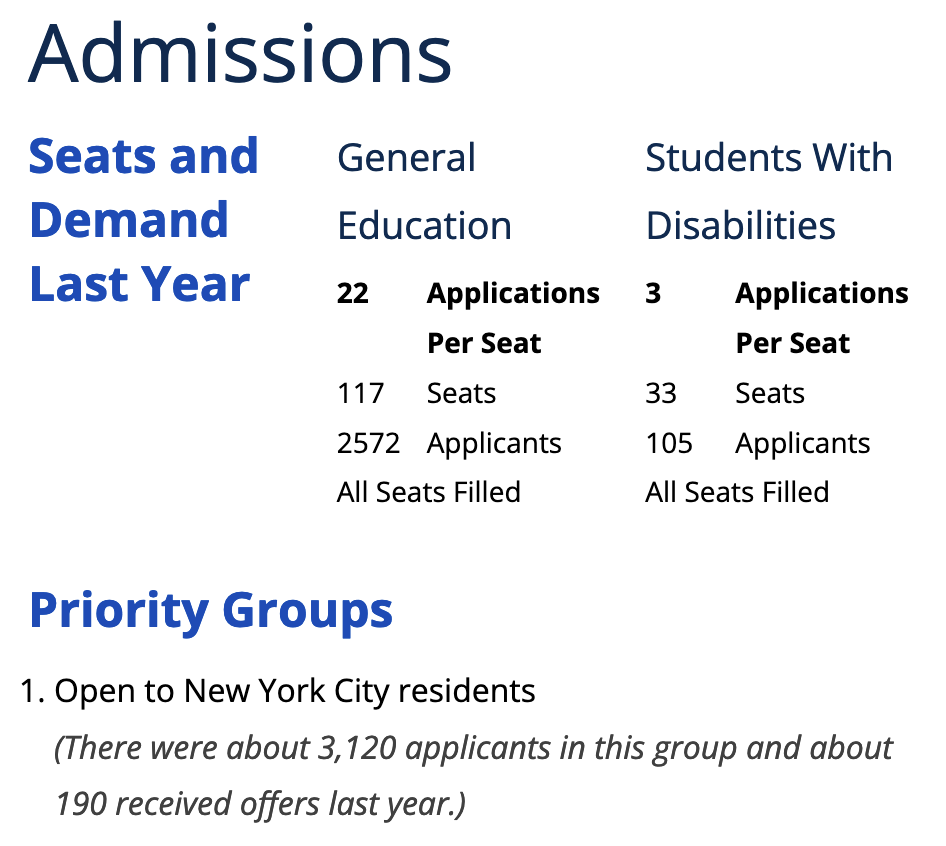
Millennium has 117 general ed seats and 33 SWD seats. Total 150 seats in the Freshmen class. They made offers to 190 students last year. Even though that is more than seats available, no one will be turned away. It is very likely that a bunch of those students will decide to go elsewhere. If Millennium is very popular this year, then its classrooms will be more full than normal, and people won’t move off the waitlist.

These numbers are particularly helpful when looking at 6-12th grade programs, because they will tell you how many people, who were not returning 8th graders, were offered seats.

I want to be proactive in high school admissions

I want to be proactive in high school admissions

Sigh. I get it. I am that person. Unfortunately, the DoE doles out information on a need to know basis. They don’t help people who want to be proactive and it often ends up as an exercise in frustration. If you push too hard, you will absolutely make this much harder for yourself than it actually is. This is a particular challenge for private school families who are considering transitioning from private to public, who are coming from a different culture and are afraid of missing something.

Read More

10th grade transfer application and waitlist - where for art thou?

By Joyce Szuflita
The 10th grade application process exists, but specific information about it is rarely seen on the DoE’s website. I have only found one mention of it under “who can apply?”. The answer is: A current eighth grade or first-time ninth grade student. That’s it! Here is the story of the 10th grade transfer.

Read More

Good luck

By Joyce Szuflita
According to the DoE high school placements will be coming out through MY SCHOOLS on Thursday March 9. If your child took the SHSAT, the results of the test, and LaGuardia auditions as well as your main application results will be listed there. You will receive an email when your results are available. They often stagger the results because MY SCHOOLS would crash if everyone went on at the same time.

Here is the thing. Life is uncertain. You can prepare and calculate and hope. It is hard not to fall in love with one place or another, but you can’t engineer your placement. Your mission is to prepare your child (and yourself, cause you have worked hard for this!) There is no doubt that you will be disappointed for any number of reasons, possibly just because there has been so much effort and angst.

This is what I hope students will consider when they get their placement:

This school is all potential.
It will be what I make of it.
I don’t know those kids, but my new best friend for life is somewhere in that crowd.
My first love is probably in there too.
There will be a teacher that I will never forget in that building.
There will be some uncontrollable laughter.
There will be something that seemed nearly impossible that I will conquer.
I will likely be sorry to leave at the end of it all.

You can focus on what you desire, but you don’t always get it, and you might even be sorry if you did, because you would have missed the wonderful thing that appeared when you least expected it. Go out and find it.